Membrane Bioreactor: The Future of Wastewater Treatment
MR
Michael Rodriguez
Water Treatment Expert
Jan 15, 2024 • 5 min read
Explore how MBR technology is transforming wastewater treatment with superior effluent quality, compact design, and sustainable water reuse capabilities.
Membrane Bioreactor (MBR) technology represents one of the most significant advances in wastewater treatment in recent decades. By combining biological treatment with membrane filtration, MBR systems deliver exceptional effluent quality while dramatically reducing the physical footprint required for treatment facilities.
Understanding MBR Technology
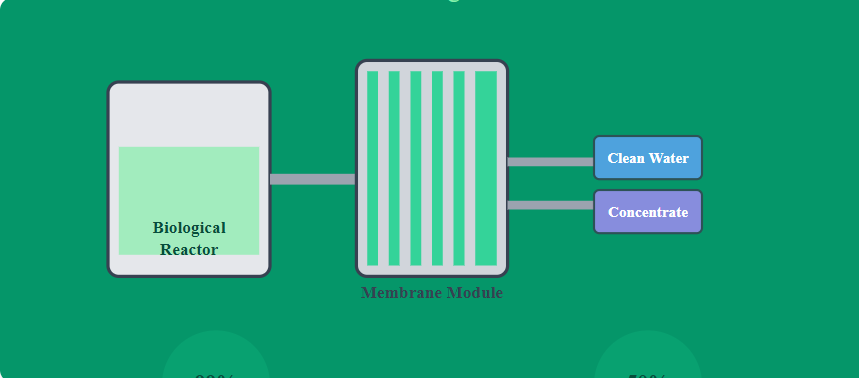
At its core, MBR technology integrates two proven treatment processes: activated sludge biological treatment and membrane filtration. This combination eliminates the need for secondary clarifiers and produces effluent quality that often exceeds traditional treatment methods by orders of magnitude.
Performance Advantage
MBR systems typically achieve <5 mg/L BOD, <2 mg/L TSS, and >4-log pathogen removal, making the effluent suitable for direct reuse applications.
Key Advantages of MBR Systems
1. Superior Effluent Quality
The membrane barrier in MBR systems provides absolute retention of suspended solids and pathogens, resulting in crystal-clear effluent that meets the most stringent discharge standards and reuse requirements.
2. Compact Footprint
By eliminating the need for secondary clarifiers and allowing higher mixed liquor suspended solids (MLSS) concentrations, MBR systems can reduce the required footprint by 50-75% compared to conventional activated sludge systems.
3. Enhanced Process Stability
The physical barrier provided by membranes ensures complete biomass retention, allowing for longer sludge retention times (SRT) and improved treatment of slowly biodegradable compounds and nitrification.
MBR Configuration Options
Immersed MBR
Membranes are submerged directly in the bioreactor, offering lower energy consumption and simplified operation.
Side-Stream MBR
Mixed liquor is pumped to external membrane modules, providing higher flux rates and easier membrane maintenance.
Applications Across Industries
Municipal Wastewater Treatment
MBR technology is increasingly adopted for municipal applications, particularly in areas with strict discharge requirements or where land availability is limited. The technology enables direct potable reuse in water-scarce regions.
Industrial Applications
Industries such as food and beverage, pharmaceuticals, and petrochemicals utilize MBR systems to treat complex wastewater streams while recovering valuable water resources for process reuse.
Case Study
A major brewery implemented MBR technology to treat 2,000 m³/day of wastewater, achieving 85% water recovery for process reuse and reducing freshwater consumption by 1.7 million liters annually.
Design Considerations and Best Practices
Membrane Selection
Choosing the right membrane type is crucial for optimal performance. Factors to consider include:
Pore Size: Typically 0.1-0.4 μm for microfiltration or 0.01-0.1 μm for ultrafiltration
Material: PVDF, PES, or PTFE based on chemical compatibility and fouling resistance
Configuration: Hollow fiber, flat sheet, or tubular based on application requirements
Flux Rate: Balancing productivity with membrane longevity
Process Optimization
Successful MBR operation requires careful attention to several key parameters:
Biological Parameters
MLSS concentration, SRT, HRT, dissolved oxygen (DO), and nutrient ratios.
Membrane Parameters
Transmembrane pressure (TMP), aeration rate, relaxation/backwash cycles, and chemical cleaning intervals.
Economic Considerations
While MBR systems typically have higher capital costs than conventional treatment, the total cost of ownership often favors MBR due to:
Reduced Land Requirements: Lower site acquisition and preparation costs
Water Reuse Value: Revenue from treated water sales or reduced freshwater purchases
Regulatory Compliance: Avoiding penalties and meeting future discharge standards
Operational Efficiency: Automated operation and reduced labor requirements
Future Developments
The MBR industry continues to evolve with several exciting developments on the horizon:
Advanced Membrane Materials
Next-generation membranes with enhanced fouling resistance and higher permeability are reducing operational costs and improving system reliability.
Smart Process Control
AI-driven control systems are optimizing membrane cleaning cycles, reducing energy consumption, and predicting maintenance needs.
Integrated Resource Recovery
Future MBR systems will incorporate nutrient recovery, energy generation, and valuable product extraction capabilities.
Conclusion
MBR technology represents a paradigm shift in wastewater treatment, offering unparalleled effluent quality, compact design, and water reuse capabilities. As water scarcity increases and environmental regulations become more stringent, MBR systems will play an increasingly important role in sustainable water management.
The key to successful MBR implementation lies in proper system design, appropriate membrane selection, and optimized operation. With continued technological advances and decreasing costs, MBR technology is poised to become the standard for advanced wastewater treatment applications.
Explore MBR Solutions for Your Facility
Our experienced team can help you evaluate MBR technology for your specific wastewater treatment needs and design a system that maximizes performance while minimizing costs.